


Back in time, Mountain pass Vršič, Slovenia
How the road over the Vršič mountain pass was built

This post is also available in:


How the road over the Vršič mountain pass was built
How the road over the Vršič mountain pass was built
How the road over the Vršič mountain pass was built
Blažej Anton (March 1952)
(page 125-128)
It is a holiday, Saturday afternoon. The train has puffed its way into Kranjska Gora. Crowds of hikers pour out of it. They split into smaller groups and hurried along at a quick, eager pace, loaded with backpacks, cheerful and smiling, along the beautiful white road toward the mountains.
Although the people of Trenta had trading connections with Kranjska Gora even in ancient times, they were linked to it only by a modest path for a long time. The Trenta people made themselves pleasant shortcuts through shady forests so that the burning sun would not scorch them as they carried heavy loads. From Klin all the way to Erjavčeva koča, the slopes were covered with thick spruce, larch, and beech forest. If we look at old photographs, we see that Erjavčeva koča once stood in the middle of a forest. The southern side of Vršič was similarly wooded, especially the slope from Tičarjev Dom toward Prisojnik, as evidenced by numerous tree stumps to this day.
How the road over the Vršič mountain pass was built
How the road over the Vršič mountain pass was built
Only shortly before the First World War did timber merchants begin to take an interest in the fine wood. They felled only a few of the most beautiful larches. The greatest devastation occurred during the First World War, in 1915, when the Austrians built the road across Vršič. In many places, massive trunks had to be cut down to make way for the new road. Large amounts of wood were used for the many bridges along it. Wooden retaining walls were built where the soil was unstable. Numerous military buildings were erected, mostly of wood. The army also consumed great quantities of wood for fuel. Time did the rest, as thinned larches were cut down and thrown from steep slopes into gravel gullies, which constantly widened due to erosion and buried old forest stands under debris.
On the Vršič saddle, in old times, a small lake refreshed and cooled the Trenta carriers. Its place—a large, elongated, and deep hollow—is still clearly visible. The lake was probably fed by the present spring below Erjavčeva koča. This beautiful lake disappeared in 1919. It is not known whether this was caused by blasting rock for a new bridge built by the Italians, or by changes in the ground that diverted the underground watercourse and shifted the spring.
Seventy years ago, Vršič was still a place of peaceful calm. The only disturbance came from shepherds and cheesemakers from Kranjska Gora and Bohinj, who had their hut—the only one on Vršič—in a grassy hollow below the saddle on the Trenta side, somewhat below today’s shepherds’ shelter.
In 1906/07, large military manoeuvres of the Austro-Hungarian army took place across Vršič and throughout the Soča Valley, attended by the heir to the throne, Archduke Franz Ferdinand. All branches of the army were represented, from infantry and artillery to cavalry. At that time, the first provisional carriage road from Kranjska Gora to Trenta was built, enabling the artillery to transport heavy guns across Vršič. Several wooden bridges were constructed. The artillery wagons were too wide and their wheels too large, so farmers from Kranjska Gora had to lend wheels, and the soldiers made beech axles to allow transport along the narrow route. Parts of this road can still be traced today along the shortcut from Erjavčeva koča to the Russian Chapel.

How the road over the Vršič mountain pass was built
How the road over the Vršič mountain pass was built
In 1900, the Austrian Alpine Club built the first mountain hut on Vršič—today’s Erjavčeva koča. In 1912, the Slovenian Alpine Society built Tičarjev Dom on Vršič. Mihov Dom was later built by Yugoslav border guards as a winter station. During the occupation, it was requisitioned by a German from Villach, who refurbished it and added another storey. For summer use, the border guards built a fine house right on the summit of Vršič.
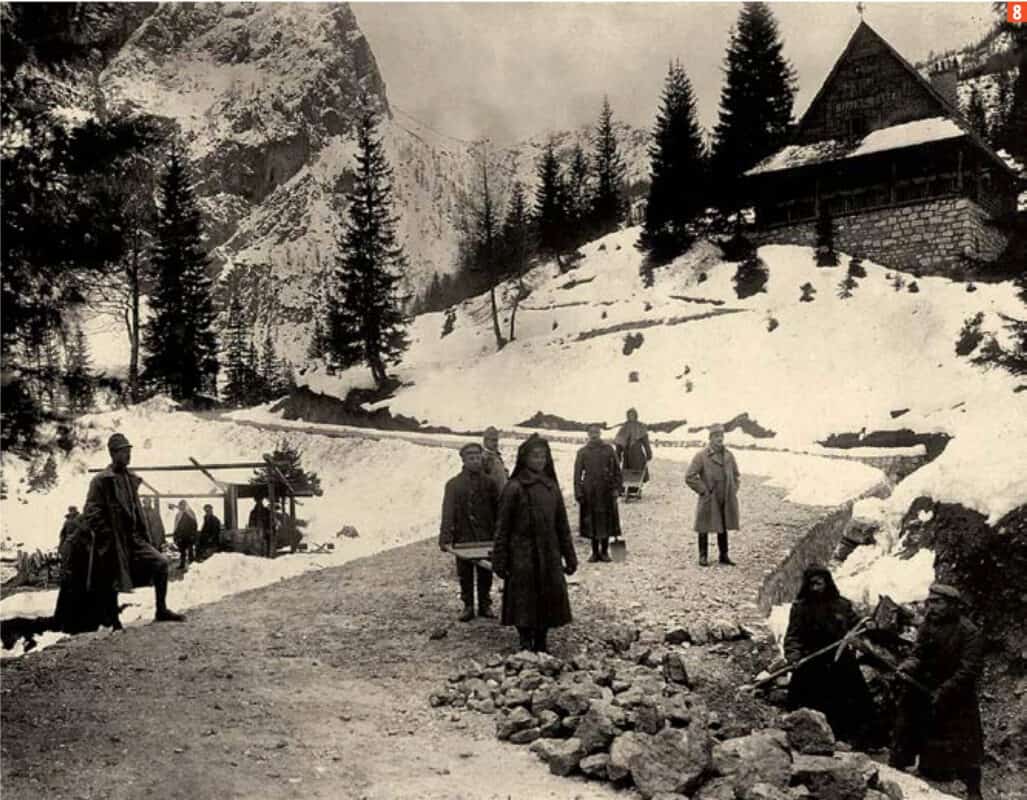
In May 1915, Italy declared war on Austria. Austria was taken by surprise. Its troops were fighting in Serbia and Galicia against the Russians. Along the Italian border, there were only border guard units. A division of Hungarians was stationed at Smohorje in the Gail Valley. Troops were rushed to the new front. Austrian engineers arrived and designed the road from Kranjska Gora to Trenta. Hundreds of Russian prisoners of war were brought in, later followed by Italian prisoners. Picks and shovels rang out. The lonely, once-peaceful mountain solitude was suddenly transformed into a military rear area. Sharp commands and orders rang out from Austrian officers. The prisoners of war began their own Way of the Cross.
The road over Vršič was urgently needed to supply the troops on the Soča Front. The main military command had its headquarters in the village of Soča, about eight kilometres from Log in Trenta toward Bovec. Fighting took place on Mount Krn and near Bovec. Austria suddenly lost the summit of Krn on 16 June 1915. During the night, the Italians crept to the top and surprised the Hungarians, who were not fully alert. One version even claims there was treachery.
The road was beautifully and boldly designed. It was surely intended to serve well in peacetime as well. Its length is about thirty kilometres. Enormous work had to be completed in a very short time, so construction began simultaneously in several sectors. Within three months, emergency traffic was already operating.
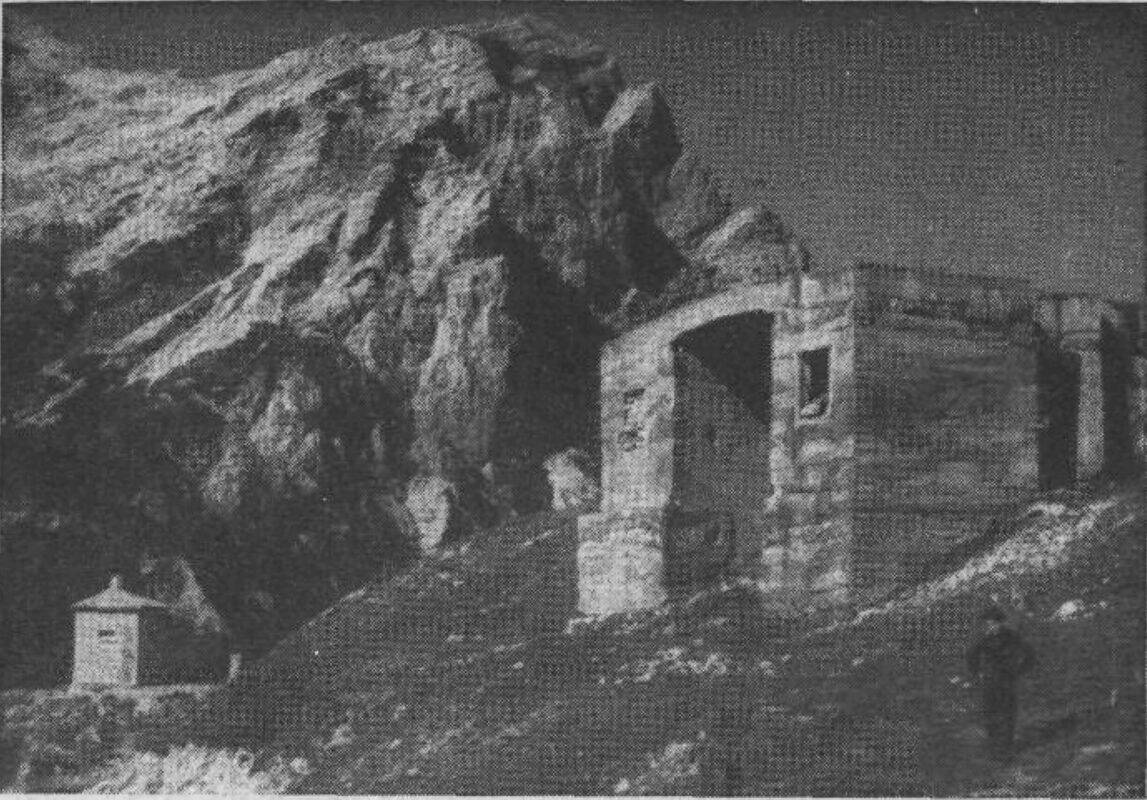
From the railway station in Kranjska Gora, a cableway was built to Trenta. From Kranjska Gora, it ran straight to Klin, then turned toward Erjavčeva koča. Today, the high-voltage power line follows this exact route. Somewhat below Erjavčeva koča, a ruined masonry building still stands by the road; it was a cableway station. From there, the cableway ran straight toward Prisojnik. Slightly below the summit of Vršič, a solid concrete building (visible from afar) still stands, the second preserved station. The third consisted of concrete ruins on the summit of Vršič, a few hundred meters from the western wall of Prisojnik. Traces of a fourth station are clearly visible at Šupce above Trenta, beside the road about half an hour’s walk from the Vršič saddle.

How the road over the Vršič mountain pass was built
How the road over the Vršič mountain pass was built
Those were extremely lively times in Kranjska Gora, on Vršič, and in Trenta. Freight trains full of soldiers arrived in Kranjska Gora. There, they were usually stationed for days or weeks, depending on the situation at the front and the orders of Austrian generals. Long marching columns moved along the road over Vršič toward the Soča Front.
Around the railway station in Kranjska Gora, a large village of barracks sprang up, serving as warehouses and barracks. In the garden of the Slavec Hotel in Kranjska Gora stood a large military hospital. Toward Klin, at Klin, near the Russian Chapel, around Erjavčeva Koča, and indeed everywhere along the road where even a small suitable space could be found—and likewise from Vršič down toward Trenta as far as Log—larger and smaller wooden buildings stood everywhere. Anyone interested in locating these structures can still determine many of their former locations today by the levelled ground and stone foundations, especially visible around Erjavčeva Koča.
The huts served primarily as accommodation for prisoners of war, densely fenced and surrounded by barbed wire. Some of the larger buildings were hospitals. To the right of Erjavčeva Koča, on both sides of the road, stood two large buildings (their traces still visible today). They served as barracks, a hospital, and a bakery. In the winter of 1916/17, enormous amounts of snow fell; it was determined that no such severe winter had occurred in the previous 35 years. These two buildings were protected from avalanches by constructing an enormous wooden bridge above them, calculating that the avalanche would pass over it like water over a weir.
On the night of 13–14 February 1917, huge masses of snow broke loose from Mojstrovka and Robičje. The bridge did not withstand the tremendous pressure; it collapsed, sweeping both buildings away. Several hundred people died suddenly and horribly beneath the white cover. Allegedly, only the baker survived, as he happened to be putting bread into the oven.
How the road over the Vršič mountain pass was built
How the road over the Vršič mountain pass was built
Construction work on Vršič was led by Engineer Kohler. The military commander was Lieutenant Colonel Rimi, a Sudeten German. He married a woman from Kranjska Gora and did not leave the town until 1925. The headquarters were located in today’s Koča na Gozdu, which was built for that purpose. Engineer Kohler and Lieutenant Colonel Rimi immortalised themselves by carving their names into the highest retaining wall above Koča na Gozdu, still visible today. The road was named Prinz Eugen Strasse; this inscription is also still visible on the same wall.
The road followed exactly the same route as today, except that below the Russian Chapel it turned left around a small hill and ran straight toward Koča na Gozdu.
Over the decades, this section nearly disappeared, but it can still be traced today.
Because Austria was unprepared for war with Italy, Italian troops quickly occupied all the important Austrian mountain peaks at the very beginning, as mentioned earlier, so the road had to be built as quickly as possible. Prisoners were forced to work from dawn to dusk. They blasted rocky slopes, excavated the wide road, laid stone foundations, filled it with gravel, built and concreted retaining walls above and below the road, constructed bridges and drainage. Austrian guards treated the prisoners with extreme brutality, driving them to work like medieval serfs. Their food was scarce and poor. People from Kranjska Gora recount that when prisoners were brought there, they searched for and ate potato peels and other waste from manure heaps. Sheep grazed on Srednji Vrh; starving Russians often stole one and slaughtered it.
Austrian officers lacked knowledge of avalanche danger. They built barracks in avalanche-prone areas. In spring and during thaws, avalanches thundered down and buried everything beneath them. Because traffic on the road had to continue uninterrupted, prisoners were forced in winter to clear snow constantly, often several meters deep; avalanches came down and buried them alive. If a hundred died, two hundred replaced them. They were mostly buried nearby, where they had died. Hence, the saying that Vršič is paved with Russian graves. Only a few graves remain preserved near Erjavčeva koča and the Russian Chapel. A large cemetery was created at that time in Kranjska Gora, on the meadow to the left of the start of today’s ski lift, where Austrians, Russians, and Italians rested together in peace.
Behind the Trenta cemetery, a Russian cemetery is still well preserved today. The exact number of victims cannot be determined; it is certain that there were around 2,000. Some claim there were as many as nine thousand.

How the road over the Vršič mountain pass was built
How the road over the Vršič mountain pass was built
If we return from Jalovec along the path on the southern slopes of Mojstrovka toward Vršič, we notice beside the usual road from Trenta another road that branches off about fifteen minutes before the Vršič saddle in the direction of Prisojnik. This old road makes a powerful impression. It is laid out very interestingly: concrete and stone-built retaining walls, two to three meters high, gleam grey. In fifteen long switchbacks, the road rises gently. It crosses about fifteen ruined wooden bridges over gullies carved by torrents. Dry-stone retaining walls are crumbling, the road is covered with gravel and sand, in places huge boulders have settled on it, and even thick larch trees have slid down from steep slopes and now grow right on the road. The eye marvels and delights in this enormous work. How much effort, sacrifice, and skill were required for a road to run through such wild and steep terrain? It is laid out even more boldly than the road past Erjavčeva koča.
Below Prisojnik, the road begins to descend, winding through many long, beautiful switchbacks, some completely buried, others perfectly preserved and covered with grass and larch needles. Walking along it is a great pleasure. This road leads to a large pasture above Koča na Gozdu, where it joins the road toward Erjavčeva koča. It served winter traffic, as avalanches could not bury it.
Such, roughly, is the history of the construction of the road over Vršič—cruel and bloody. Prisojnik, the enormous rocky massif with its proud, white, gleaming northern wall, divided into tall towers and deeply cut gullies, was witness to all that happened at its foot. Perhaps that is why it seems to bow its head so sadly. A pity it cannot speak.
* Unfortunately, no written sources can be found; the data are based on the testimonies of older residents of Kranjska Gora and Trenta.

How the road over the Vršič mountain pass was built

source: here
How the road over the Vršič mountain pass was built
Accommodation in a mountain hut


 Slovenščina
 English
 English
 Bosanski
 Dutch
Dutch
 Hrvatski
 Čeština
 Dansk
Dansk
 Dutch
Dutch
 Suomi
Suomi
 Français
 Deutsch
 Magyar
 Italiano
 Polski
 српски
 Slovenčina
 Español
 Svenska
 Deutsch
Trips and Hikes around the hut



Your next destination in slovenia?

Erjavčeva mountain hut is open the whole year. Reserve your stay and spend some time in the natural paradise of Triglav National Park (UNESCO) near Kranjska Gora on Vršič mountain pass in the heart of Triglav National Park.
Reserve your stay
Slovenščina
English
English
Bosanski
Dutch
Hrvatski
Čeština
Dansk
Dutch
Suomi
Français
Deutsch
Magyar
Italiano
Polski
српски
Slovenčina
Español
Svenska
Deutsch
Souvenirs Online Shop
-30%

Original price was: 20 €.14 €Current price is: 14 €.
-38%

Pedestal
Price range: 5 € through 6 €
-38%

Pedestal
Price range: 5 € through 6 €
-30%

Original price was: 20 €.14 €Current price is: 14 €.


